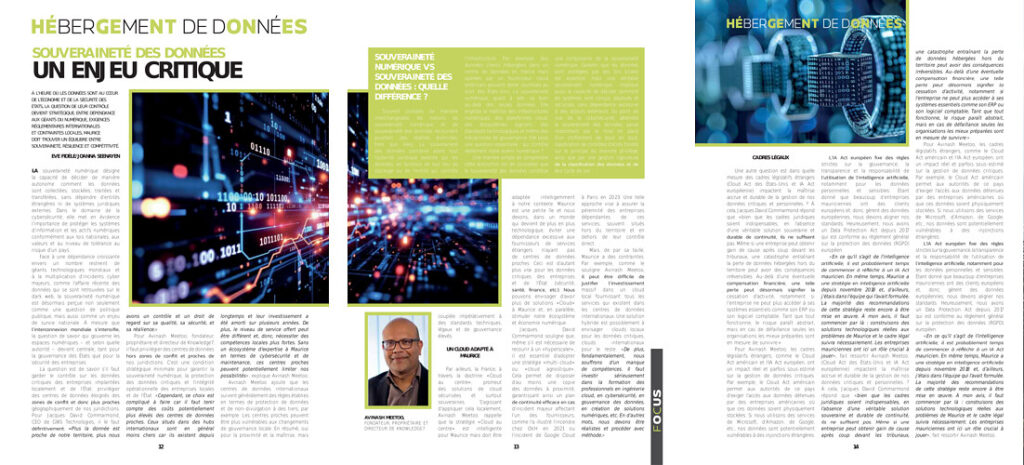
Three weeks ago, I answered a few questions from Eve Fidèle and Joanna Seenayen for the Tech Trends supplement of the April 2026 edition of Business Magazine. The questions focused on Data Sovereignty and the IT infrastructure of Mauritius.
I stated that the major challenge for Mauritius lies in guaranteeing technological sovereignty through the strategic management of its digital infrastructure. For instance, it is imperative to prioritise data centres located outside conflict zones and in close proximity to Mauritius to protect critical data and maintain operational integrity. While international hubs offer lower amortized costs, proximity allows for better control, provided it is supported by high technical and governance standards.
A “Cloud-centric” approach must be adapted to the realities of our small island state. A hybrid model is recommended: local cloud for sensitive sectors such as health, security, and finance, and international cloud for less critical data. This transition cannot succeed without a serious investment in human capital. The skills gap in cloud engineering, cybersecurity, and data governance is a major hurdle that must be overcome through the continuous training of professionals.
On the legal front, vigilance is required regarding foreign frameworks such as the US Cloud Act, which allows third-party authorities to access data even if it is stored outside their territory. While our current framework is compliant with the European GDPR thanks to the 2017 Data Protection Act, technological evolution calls for a new reflection on artificial intelligence. Rather than rushing into a Mauritian “AI Act”, the priority must be to finally implement the recommendations of the 2018 and 2026 national strategies. It is a matter of building concrete technological solutions to local problems, with the legislative framework naturally following innovation. Sovereignty is not simply decreed by laws: it is built through technical expertise and choices of effective solutions.